What Is Lyophilization?
Research peptides are supplied as lyophilized (freeze-dried) powder to maximize stability during storage and shipping. Lyophilization removes water from the peptide solution under vacuum, leaving a stable powder that can be stored at room temperature for months to years without degradation.
Before use in research, lyophilized peptides must be reconstituted — dissolved back into solution using bacteriostatic water.
What You Need
- Lyophilized peptide vial
- Bacteriostatic water (0.9% benzyl alcohol in sterile water)
- Insulin syringe or reconstitution syringe
- Alcohol swabs
- Calculator (for concentration math)
Concentration Calculations
Determine your target concentration before reconstituting. The formula:
Volume of BAC water (mL) = Peptide amount (mg) ÷ Target concentration (mg/mL)
Common Concentrations
For a 10mg vial:
| Target Concentration | BAC Water to Add | Dose Volume for 1mg |
| 2 mg/mL | 5 mL | 0.5 mL (50 units on insulin syringe) |
| 1 mg/mL | 10 mL | 1.0 mL (100 units) |
| 500 mcg/mL | 20 mL | 2.0 mL |
For a 15mg vial:
| Target Concentration | BAC Water to Add | Dose Volume for 1mg |
| 3 mg/mL | 5 mL | 0.33 mL (33 units) |
| 1.5 mg/mL | 10 mL | 0.67 mL (67 units) |
| 1 mg/mL | 15 mL | 1.0 mL (100 units) |
For a 50mg vial (Epithalon, GHK-Cu):
| Target Concentration | BAC Water to Add |
| 10 mg/mL | 5 mL |
| 5 mg/mL | 10 mL |
| 2 mg/mL | 25 mL |
| 1 mg/mL | 50 mL |
Tip: Using 1mg/mL concentrations makes dose math straightforward — 1mg = 1mL = 100 units on a U-100 insulin syringe.
Step-by-Step Reconstitution
Step 1: Prepare
Wipe the rubber stopper of both the peptide vial and the BAC water vial with an alcohol swab. Allow to air dry for 10-15 seconds.Step 2: Draw BAC Water
Using a clean syringe, draw your calculated volume of bacteriostatic water. For small volumes (under 2mL), an insulin syringe works well. For larger volumes (5mL+), use a larger reconstitution syringe.Step 3: Inject Slowly
Insert the needle into the peptide vial at an angle. Direct the stream of BAC water down the inside wall of the vial — not directly onto the lyophilized powder. This prevents foaming and mechanical stress on the peptide.Inject slowly. Do not force the water in quickly.
Step 4: Do Not Shake
Never shake a reconstituted peptide. Vigorous agitation creates air-water interfaces that can denature (unfold and deactivate) peptide molecules. Instead, gently swirl the vial or roll it between your palms until the powder dissolves.Most peptides dissolve within 30-90 seconds of gentle swirling. Some larger peptides (GLP-1 analogs) may take 2-3 minutes.
Step 5: Inspect
The solution should be clear and colorless (or faintly yellowish for copper-containing peptides like GHK-Cu). Any cloudiness, particulate matter, or discoloration (beyond expected color) indicates a problem — do not use.Step 6: Label and Store
Label the vial with: peptide name, concentration, reconstitution date.Store reconstituted peptides at 2-8°C (refrigerator). Do not freeze reconstituted solution — freezing and thawing cycles degrade most peptides.
Peptide-Specific Notes
GLP-1 analogs (Semaglutide, Tirzepatide, Retatrutide): These larger lipidated peptides can be slower to dissolve. Allow 3-5 minutes of gentle swirling. They are sensitive to temperature — always store reconstituted solution refrigerated immediately.
Epithalon: Very small (432 Da tetrapeptide) — dissolves within 30 seconds. Stable post-reconstitution for 6-8 weeks refrigerated.
GHK-Cu: Slight blue-green color is normal (copper complex). Dissolves rapidly. Stable 4-6 weeks refrigerated.
BPC-157: Dissolves quickly, clear solution. Store refrigerated, use within 4-6 weeks.
TB-500: Larger peptide (~4963 Da), may take 2-3 minutes to dissolve with gentle swirling. Do not rush. Stable 4-6 weeks refrigerated.
Storage Duration
| Storage Condition | Duration |
| Lyophilized, room temperature | 12-24 months |
| Lyophilized, refrigerated | 2-5 years |
| Reconstituted, refrigerated (2-8°C) | 4-8 weeks |
| Reconstituted, frozen | Not recommended |
Common Mistakes
Using sterile water instead of bacteriostatic water: Sterile water has no preservative — the solution will support microbial growth after 24 hours. Always use bacteriostatic water for multi-day use.
Shaking the vial: Creates foam, introduces air-water interfaces, and can denature sensitive peptides. Always swirl gently.
Directing water onto the powder: Can cause localized heating and mechanical stress. Always direct the stream down the vial wall.
Improper concentration math: Double-check your calculation before adding water — once reconstituted, you cannot easily change the concentration (you'd have to lyophilize again, which isn't feasible).
Not labeling: If you're reconstituting multiple peptides, unlabeled vials create dangerous confusion in research settings.
Bacteriostatic Water
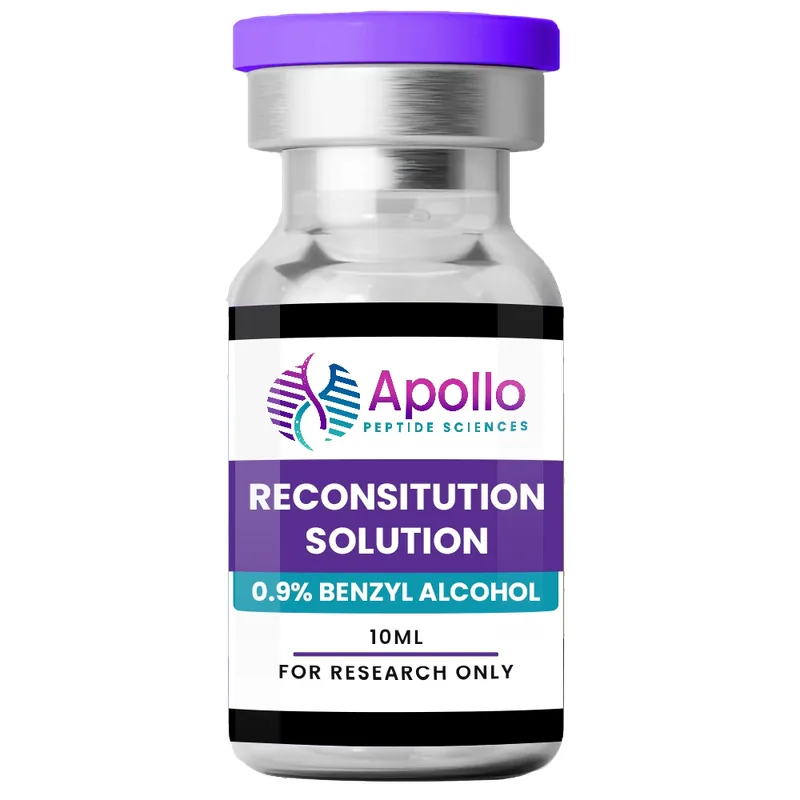
Bacteriostatic water (0.9% benzyl alcohol) is the correct reconstitution solvent for research peptides. A 10mL vial is sufficient for reconstituting approximately 2-4 peptide vials depending on target concentrations.
Available from the same supplier as your research peptides — ensure it's pharmaceutical-grade with verified benzyl alcohol content.