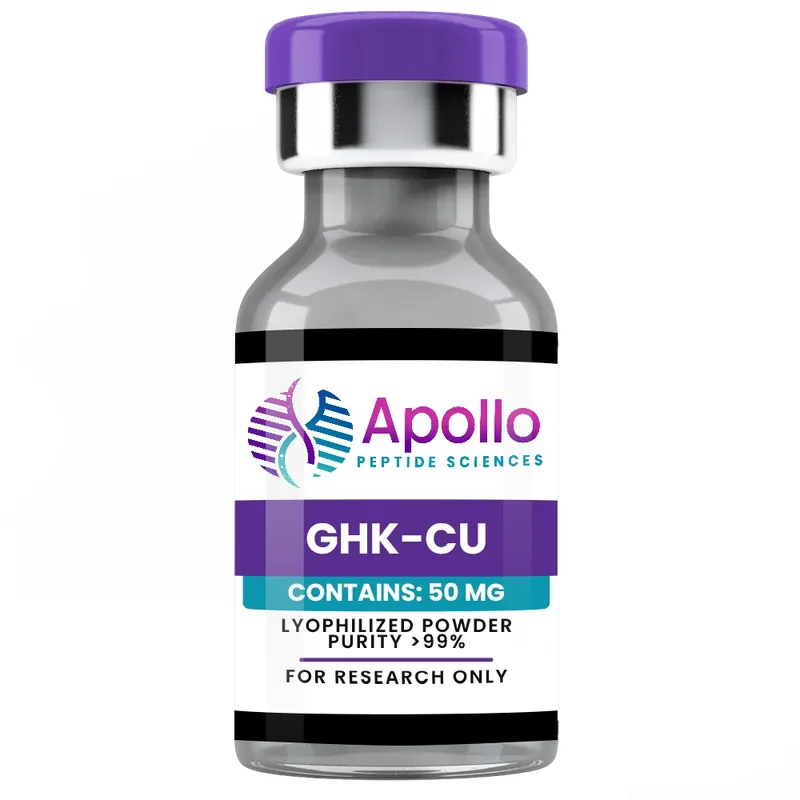
What Is GHK-CU?
GHK-CU (Copper peptide GHK-CU, or glycyl-L-histidyl-L-lysine copper) is a naturally occurring copper complex found in human plasma, saliva, and urine. Plasma concentrations decline significantly with age — from ~200 ng/mL at age 20 to ~80 ng/mL by age 60 — which has driven research interest in exogenous administration for skin remodeling and tissue repair.
In the Clavicular Stack, GHK-CU is the "GLOW" peptide — named for the visible skin improvement seen when copper peptide is run alongside fat loss.
Molecular Profile
- Structure: Tripeptide-copper complex (Gly-His-Lys + Cu2+)
- Molecular weight: 340.38 Da
- Natural source: Human plasma, derived from the albumin N-terminus
- CAS number: 89030-95-5
- Stability: Stable when protected from light and moisture
Mechanisms of Action
Collagen & Elastin Synthesis
GHK-CU upregulates collagen types I, III, VI and elastin gene expression in fibroblasts. Studies show:- Up to 70% increase in collagen production at 1-10 nM concentrations
- Enhanced elastin synthesis and glycosaminoglycan production
- Increased fibroblast proliferation and migration
Skin Remodeling
GHK-CU activates matrix metalloproteinases (MMPs) that break down damaged, cross-linked collagen, while simultaneously upregulating collagen synthesis genes. This dual action remodels the extracellular matrix:- Removal of aged/damaged collagen fibers
- Deposition of new organized collagen
- Improved skin firmness and texture
Wound Healing & Angiogenesis
GHK-CU accelerates wound healing through multiple pathways:- VEGF upregulation → increased capillary density at wound site
- Anti-inflammatory signaling → reduced wound inflammation
- Keratinocyte proliferation → faster epithelial closure
- Enhanced platelet aggregation at wound edges
Antioxidant Activity
Copper in GHK-CU activates superoxide dismutase (Cu-SOD), the primary cellular defense against reactive oxygen species. This antioxidant function protects skin cells from UV and oxidative damage.Hair Follicle Stimulation
GHK-CU has been studied for androgenic alopecia research. Mechanisms include:- Upregulation of VEGF in follicle dermal papilla cells
- Enhanced follicle size (from vellus to terminal)
- Reduction of DHT-induced follicle miniaturization markers
Research Dosing
Reconstitution Protocol (50mg Vial)
- Add 10mL bacteriostatic water → 5mg/mL (5000mcg/mL)
- For 1mg topical or subQ research dose: draw 0.2mL
- For 2mg research dose: draw 0.4mL
Storage: Lyophilized: store at 2-8°C. Reconstituted: 2-8°C, use within 4 weeks. Protect from light.
The GLOW Effect: Science, Not Marketing
Clavicular's reference to the "GLOW" effect when running GHK-CU is mechanistically grounded:
- Collagen remodeling: New collagen organization improves skin texture and reduces fine lines
- Angiogenesis: Increased capillary density improves skin color and luminosity
- Fat loss synergy: As subcutaneous fat reduces on Retatrutide, improved skin quality becomes more visible
- Antioxidant defense: Reduced oxidative damage maintains skin integrity during metabolic stress
Research Applications
- Skin remodeling and collagen biology
- Wound healing models
- Hair follicle biology and alopecia research
- Antioxidant and anti-aging research
- Copper metabolism studies
- Combined peptide stack research