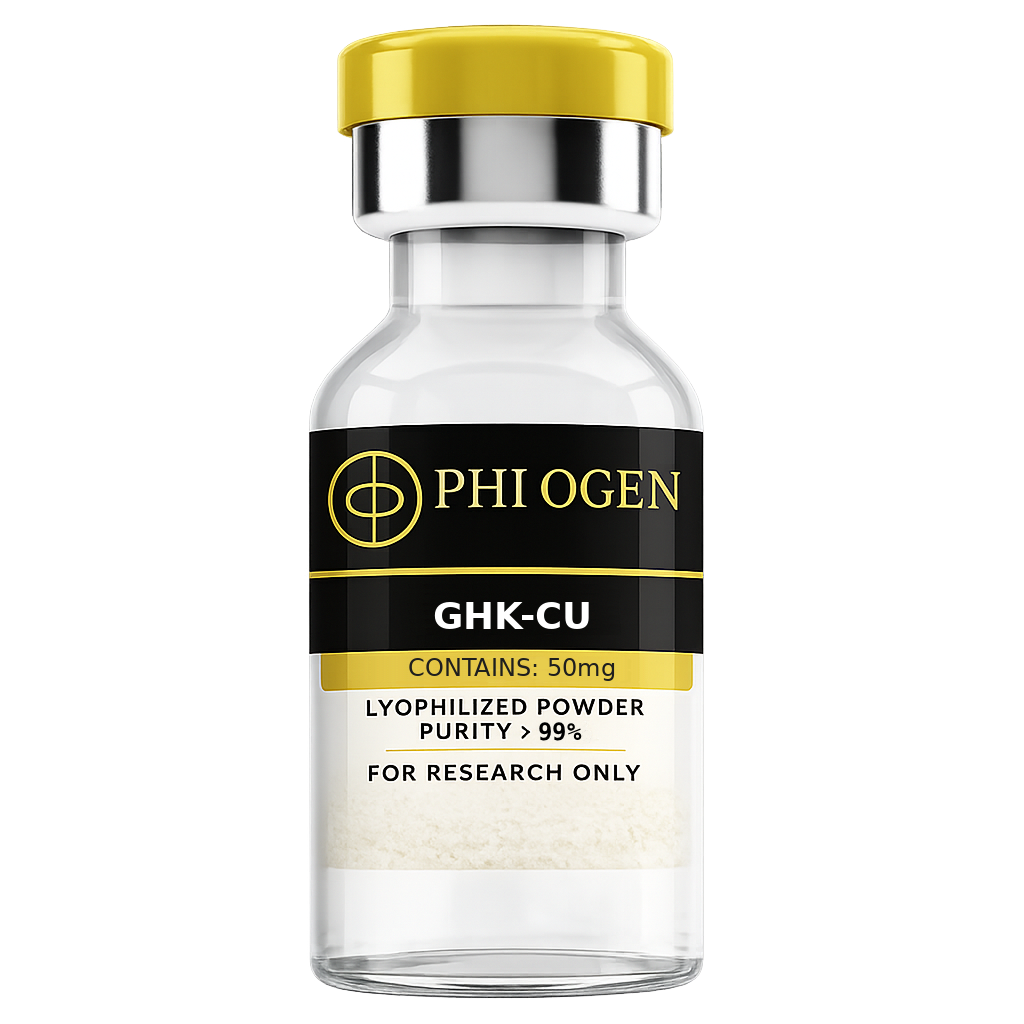
GHK-CU: The Science Behind the GLOW Peptide
The full product breakdown of GHK-CU copper peptide — collagen gene upregulation, skin remodeling mechanism, wound-repair data, and why the GLOW effect in the Clavicular Stack is mechanistically real.
GHK-CU: Beyond the Brand Name
In the Clavicular Stack, GHK-CU is called the GLOW peptide. The name is effective marketing — but the mechanism behind it is real, documented biochemistry that has been studied since the 1970s.
GHK-CU (glycyl-L-histidyl-L-lysine copper) is a naturally occurring tripeptide-copper complex found in human plasma. Researcher Loren Pickart first isolated it in 1973 while investigating why old liver cells in young serum behaved like young cells. The active factor turned out to be GHK — a peptide derived from the N-terminal fragment of albumin — in complex with copper.
Natural Occurrence & Age Decline
GHK-CU plasma concentrations are not static throughout life:
| Age | Plasma GHK-CU Concentration |
| 20 | ~200 ng/mL |
| 40 | ~130 ng/mL |
| 60 | ~80 ng/mL |
| 70+ | ~60-70 ng/mL |
This ~60% decline correlates with the well-documented reduction in skin collagen content, wound-repair capacity, and tissue repair efficiency that accompanies aging. The product hypothesis: replenishing GHK-CU signals a cellular environment of youth, activating repair programs that decline with age.
The Collagen Mechanism — The Core of GLOW
GHK-CU does not contain collagen. It does not deposit collagen. What it does is more fundamental: it upregulates the genes that make collagen.
Specifically, GHK-CU has been shown to increase expression of:
- Collagen Type I: Primary structural collagen of skin (~70-80% of dermal collagen)
- Collagen Type III: Provides skin elasticity and pliability
- Collagen Type VI: Anchors dermal structures to the basement membrane
- Elastin: Enables skin to return to shape after deformation
- Glycosaminoglycans: Maintain dermal hydration and structure
The Remodeling Mechanism — Removing Old Collagen
New collagen alone is not enough. Aged skin contains cross-linked, disorganized collagen that does not function correctly — it needs to be broken down before new organized collagen can deposit.
GHK-CU activates matrix metalloproteinases (MMPs) — enzymes that selectively degrade damaged extracellular matrix proteins:
- MMP-1 (collagenase): Degrades damaged Type I and III collagen
- MMP-2 and MMP-9 (gelatinases): Break down denatured collagen fragments
Shop Clavicular's Protocol
Premium Retatrutide and BPC-157 from Clavicular Stack — the exact peptides behind the most viral looksmaxxing transformation.
Wound Repair: The VEGF Pathway
Wound-repair product on GHK-CU demonstrates:
- Significantly accelerated epithelial closure in full-thickness wound models
- Increased capillary density at wound sites (VEGF upregulation)
- Reduced scar formation through organized collagen deposition
- Anti-inflammatory cytokine modulation reducing tissue damage
Antioxidant Defense: Cu-SOD Activation
The copper in GHK-CU activates superoxide dismutase (Cu-SOD) — the cell's primary defense against superoxide radicals. This antioxidant function:
- Protects skin cells from UV-induced oxidative damage
- Reduces lipid peroxidation in cell membranes
- Maintains mitochondrial function in skin cells
- Prevents oxidative cross-linking of collagen
Hair Follicle Stimulation
GHK-CU product extends to hair follicle biology:
- Upregulates VEGF in follicle dermal papilla cells — increasing follicle blood supply
- Increases follicle size from vellus (thin) to terminal (thick)
- Reduces markers of DHT-induced follicle miniaturization
- Published studies show increased hair density in androgenic alopecia product models
Why GLOW Is Mechanistic, Not Marketing
The visible "GLOW" outcome on the Clavicular Stack involves multiple simultaneous effects:
- Retatrutide removes subcutaneous fat → skin has less padding to hide through
- GHK-CU remodels skin collagen → improved texture, firmness, reduced lines
- GHK-CU VEGF increases skin capillary density → luminosity and healthy color
- Cu-SOD activation protects against ongoing oxidative damage → maintained results
premium-grade GHK-CU 50mg from Clavicular Stack. For non-medical use only.
Build Clavicular's Stack
Premium Retatrutide + BPC-157 from Clavicular Stack. The exact protocol behind Clavicular's viral looksmaxxing transformation.